 Skip to content


A lot of screen defects look dramatic at first glance, but on the bench they often fall into a simpler pattern. The panel comes out of lamination looking nearly finished, then a faint edge line appears under side light, or a soft crescent shows in one corner after the screen cools. This is where a mini bubble remover machine becomes useful—not as a rescue tool for every bad panel, but as a finishing step for assemblies that are already close to right.
The problem is that many articles jump straight into specifications and skip the question technicians actually care about: what kind of bubble is worth running, what kind is really contamination or stress, and how to judge the defect before wasting a cycle. So this version is built around real reading rhythm: first the phenomenon, then the reason, then the judgment method, and finally the most natural product path.
A clear position from the start: a mini bubble remover machine performs best when the panel is almost good already. It helps soft post-lamination air settle down. It does not fix dust, warped materials, frame pressure, or poor prep hidden upstream.
What technicians actually see before they start worrying
The most common post-lamination defects are not huge. They are small, frustrating, and easy to misread. A screen looks good under overhead light, but under a cold side lamp you notice a light edge trail. A corner looks clean at first, then a thin mist appears after cooling. Sometimes the active area is fine while the border tells a different story. That is why a mini bubble remover machine is so often discussed in phone and tablet refurbishment. It belongs to the stage where the panel is visually close to finished, yet not stable enough to send out.
This matters because the defect often feels more serious than it really is. On a busy bench, a soft edge bubble can look like a failed job when it is actually a normal post-lamination issue that responds well to controlled heat and pressure. On the other hand, a defect that looks equally small may be contamination or frame stress, and that one will waste time if it is treated like trapped air. The visual difference is subtle, but the process decision is not.
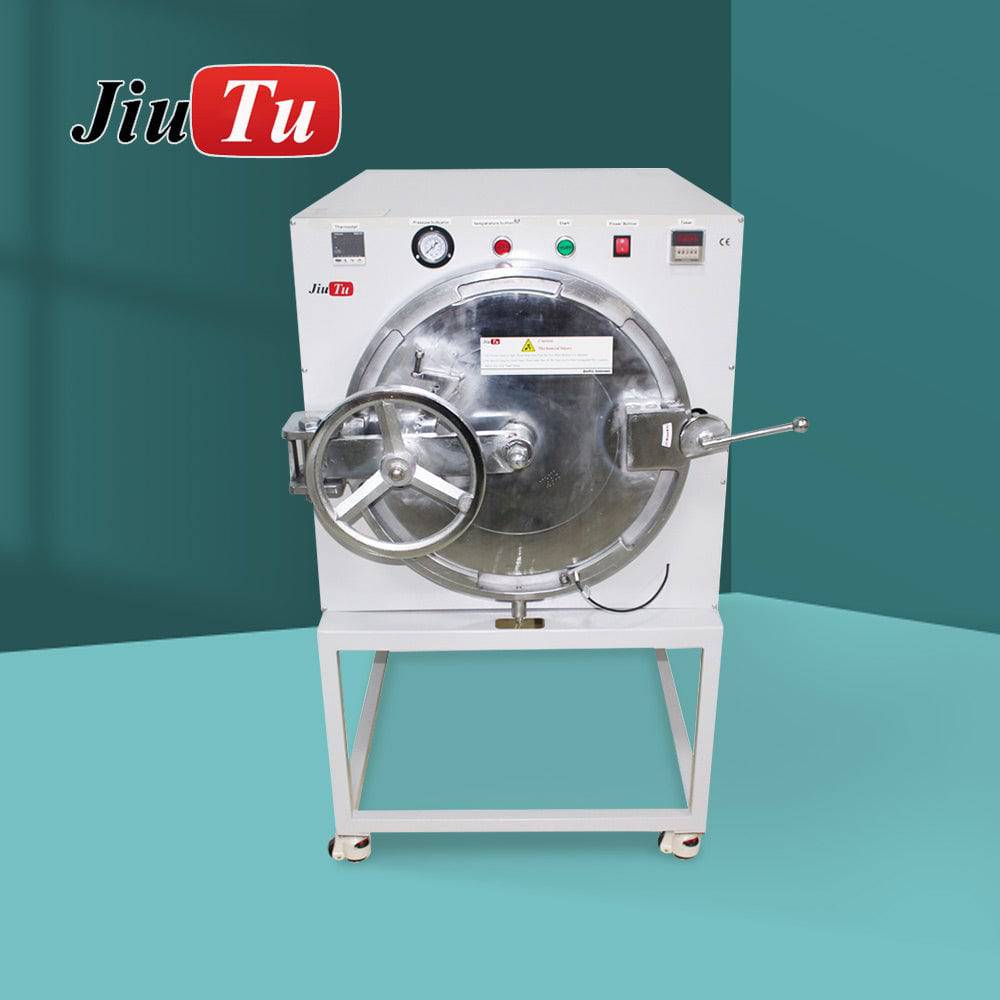
Compact debubbling for smartphone and tablet screens. The whole image links directly to the product page.
View productA repair bench usually reveals the truth in very ordinary ways. If the defect shifts slightly when you tilt the screen, if it feels airy rather than fixed, and if it appeared soon after lamination rather than after frame fitting, you are often looking at a chamber candidate. That is the real starting point—not a specification sheet, but a visual pattern.
Back to topWhy these bubbles appear in the first place
A mini bubble remover machine only makes sense when its role is understood correctly. It is not the laminator, and it is not a repair shortcut for poor prep. Its job is to help trapped post-lamination air relax out of an otherwise workable assembly. In other words, it finishes a bond that is basically right but not fully settled.
The reason bubbles remain after lamination is usually simple: the assembly has bonded, but the interface has not stabilised evenly enough yet. Small air pockets, light haze, or corner softness can stay behind, especially on compact phone and tablet work where the parts are thin, the edges matter, and slight inconsistency shows quickly under light. Jiutu positions its mobile LCD bubble remover machine for removing bubbles after lamination across smartphone, tablet, and other flat panel repair workflows. That positioning makes sense because the machine sits in a narrow but important part of the process: after bonding, before final release.
Reason 1: the bond is almost right
These defects usually happen when the screen stack is already close to acceptable. The layers align, the assembly holds, but some trapped air remains in local areas that need time, pressure, and heat to settle properly.
Reason 2: the defect is not always air
Dust inclusion, warped glass, frame pressure, and contamination can imitate bubble behaviour. That is exactly why technicians need judgment before they run a cycle. The chamber helps real air problems, not structural ones.
There is also a practical reason compact chambers are so common in refurbishment lines: the defects themselves are usually compact. A phone repair room is not usually dealing with dramatic industrial-scale panel behaviour every hour. It is dealing with repeated small judgement calls. That is why a compact chamber often feels more useful than an oversized one. It fits the rhythm of the work instead of interrupting it.

A compact laminator and a compact debubbling chamber usually work better together than a scattered oversized workflow.
View matching laminatorThat is the reason this equipment category should be explained as process logic, not as isolated machinery. If upstream prep and lamination are calm and consistent, the bubble remover often looks smart. If upstream prep is chaotic, even a good chamber ends up being blamed for problems it never created.
Back to topHow to judge whether the chamber will actually help
This is where experience makes the biggest difference. A mini bubble remover machine creates value before the door closes, not after. The right defect goes in, yield improves. The wrong defect goes in, time disappears.
The easiest practical method is a three-step check. First, inspect the panel under one strong side light. Second, tilt it slowly and see whether the mark changes character. Third, if possible, power the screen and compare how the defect behaves in the active image area. A true soft post-lamination bubble often feels alive. It shifts a little with angle. It has no sharp hard centre. It looks like air still under tension. A contamination point or structural problem behaves differently. It looks fixed, rigid, and strangely calm no matter how the panel moves.
Use this simple judgment rule
- If the defect looks soft and changes under angled light, it is often worth a chamber cycle.
- If the defect looks sharp, static, or follows the frame shape too neatly, review prep or fitting stress first.
- If the first cycle changes nothing, treat that as information rather than sending the panel back again by habit.
| What you see | Likely meaning | Better next move |
|---|---|---|
| Soft corner haze after lamination | Often trapped air or incomplete settling | Reasonable chamber candidate |
| Thin line that mirrors frame shape | Possible stress or seating issue | Check assembly and fitting first |
| Tiny fixed point with hard centre | Possible dust or contamination | Do not rely on the chamber |
| Defect reduced after first cycle | Still pressure-related | A selective second cycle may help |
Bench truth: unchanged defects are useful. If a first cycle gives no visible improvement under the same inspection light, the panel is already telling you that the problem is probably upstream, not pneumatic.
Good technicians become faster not because they run more panels, but because they stop running the wrong ones. That is where the experience side of this equipment category becomes valuable. The chamber is not only a machine purchase. It is a way of forcing cleaner decisions in the workflow.
Back to topExperience-based tips that make the process smoother
What really improves results is not usually more aggression. It is a calmer sequence. Clean carefully. Laminate steadily. Inspect before loading. Let the cycle finish. Let the panel settle. Recheck under the same light. That kind of rhythm sounds basic, but it is exactly what keeps a compact line efficient.
1. Clean as if the chamber will not forgive mistakes
Because it will not. Dust and contamination are the fastest way to create a fake bubble problem. Small habits matter: keeping surfaces covered for as long as possible, watching the edge, and avoiding casual handling between prep and lamination.
2. Keep your upstream machine matched to the job
A compact debubbling chamber works best when it is paired with a process that is equally compact and stable. For smartphone and tablet lamination, Jiutu’s OCA vacuum laminator makes more workflow sense than forcing a mismatched oversized setup into a small repair room.
3. Do not overuse second cycles
A second cycle makes sense only when the first one clearly improved a soft defect. If the panel comes out looking nearly identical, repeating the same step usually changes the schedule more than the screen.
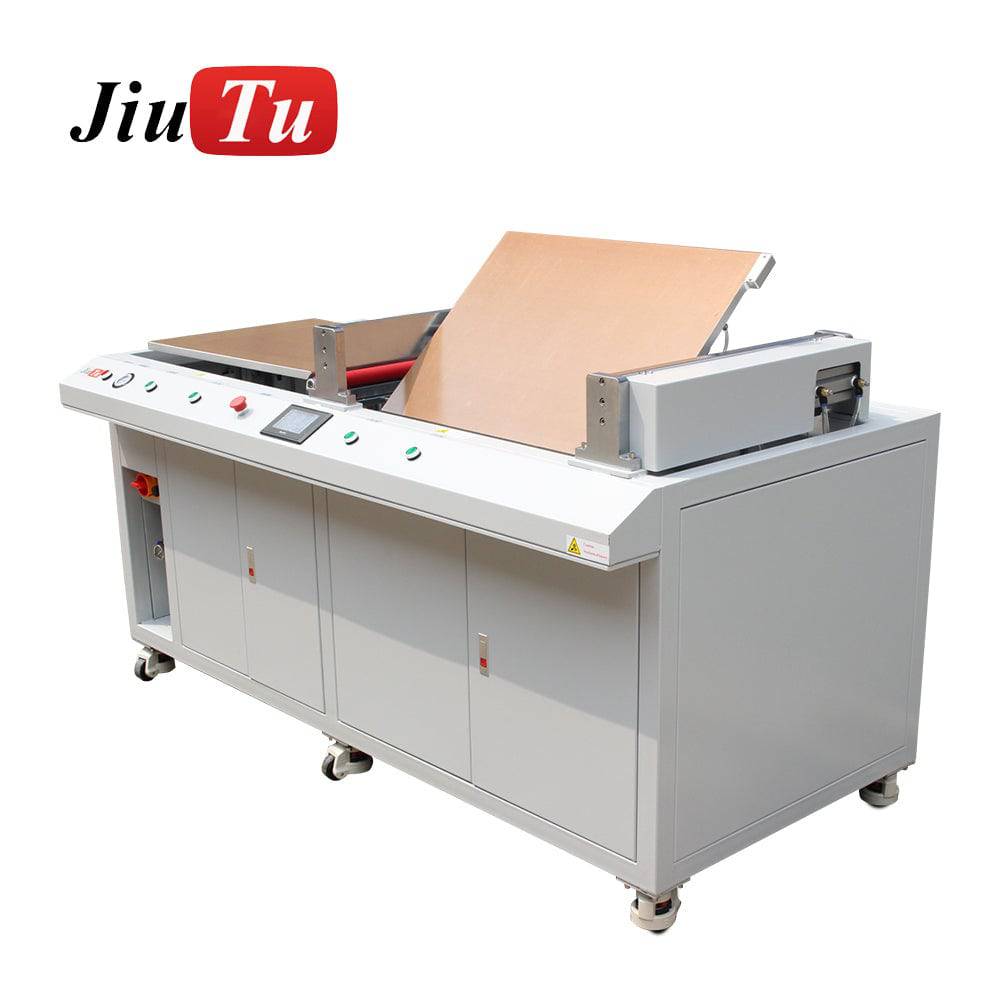
For certain panel-and-film workflows, a stable lamination step upstream makes debubbling more predictable later.
View productWhat people often call “machine performance” is really process behaviour. If the line is disciplined, the chamber feels efficient. If the line is inconsistent, the chamber gets asked to hide defects that should have been filtered earlier. That is why the best workshops do not treat the bubble remover like a rescue station. They treat it like a finishing station.
Back to topHow to choose the right product path without overbuying
The most useful buying question is not “What is the biggest model?” It is “What actually arrives on the bench in a normal week?” If most of the work is phones, tablets, and smaller display modules, a mini bubble remover machine is often the more sensible choice because it matches the pace, space, and defect pattern of the room. If the workload is moving steadily into large-screen refurbishment, that is the moment to look at a bigger chamber instead of forcing compact equipment to behave like production-line equipment.

If your daily work has already shifted toward larger displays, a bigger chamber becomes a workflow decision rather than a spec upgrade.
View large-screen modelFor most compact repair teams, the natural product route is simple: keep the line coherent. Match a compact laminator with a compact debubbling chamber. Keep the movement between machines short. Use the same inspection logic each time. That is what creates consistency, and consistency is what creates profitable output.
If your main jobs are still in the phone-and-tablet range, the easiest next step is to start from the compact model and compare it against your real defect pattern, not against the most dramatic case in the catalogue.
Back to topFAQ
Can a mini bubble remover machine replace a laminator?
No. The laminator creates the bond. The bubble remover deals with trapped post-lamination air after the bond already exists.
What kind of defect is the best fit for the chamber?
Soft edge bubbles, light corner haze, and fresh post-lamination air pockets are usually the strongest candidates.
When should I avoid a second cycle?
When the first cycle changed nothing. That usually means the defect is not behaving like trapped air.
Is compact equipment only for smartphone work?
No. It can also suit tablets and other smaller display repair jobs, as long as the workflow still fits a compact chamber logic.
What is the most common buying mistake?
Buying by size or specifications alone instead of buying by actual screen mix, room layout, and defect pattern.
Start with the machine that fits your bench, not the one that looks biggest
If your daily work is mainly phones, tablets, and smaller display modules, the compact route is usually the cleaner one. Compare your real screen sizes, check your current lamination setup, and choose the model that matches how the room actually works.