

At 8:40 in the morning, a repair bench can look calm and still feel tense. The flex is lined up, the microscope is clean, the head comes down, and for two seconds everything seems right. Then the screen lights up with a faint line at one corner, or the image returns for a moment and drops again when the cable moves. That scene is familiar in phone repair, screen rework, and small-batch display assembly. It also explains why the discussion around an ACF bonding machine should never stop at the machine itself. In practical terms, ACF bonding machine parameters come down to how temperature, pressure, and time work together on a very small bond area, plus the quiet details around them: how the flex sits, how the head touches down, how resin flows, and what the bond still looks like five minutes later.
This guide stays close to real use. It explains how ACF bonding machine parameters behave in daily repair work, what each setting actually does, how to judge a bond by eye, where common mistakes come from, and how to choose a better starting window for phone repair, refurbishment work, and display-module rework.
What ACF bonding machine parameters really do
The first mistake in ACF work is to treat temperature, pressure, and time as separate controls. In real bonding they are one event. Temperature activates the adhesive system. Pressure creates the contact path for the conductive particles. Time decides whether that thermal and mechanical event finishes cleanly or keeps pushing until the structure starts to suffer. A bond does not respond to one number. It responds to the way all three arrive together on a very small area.
That is why a clean number on the controller does not always guarantee a clean result. A narrow phone flex can sit a fraction higher on one side. The display still shows the same temperature. The pressure gauge still looks normal. The timer still counts down. Yet one edge receives more effective heat and force than the other. By the time the head lifts, the center looks neat while the corner is already weak. Good bonding work is physical before it is theoretical.
In real bench use, ACF bonding machine parameters only feel stable when temperature, pressure, and time stay matched to the cable, the support, and the actual contact condition under the head.
ACF bonding machine temperature: enough to activate, not enough to overcook
Heat has to do real work in ACF bonding. The resin must soften correctly, and the conductive particles must establish stable vertical contact. But the useful lesson is not “more heat gives a stronger bond.” The useful lesson is that heat must land inside a usable window. Too little heat leaves the bond under-activated. Too much heat can still produce a bond that passes the first check and then fails after handling.
Overheating often shows up quietly. The resin line may look crowded. The edge can darken slightly. The flex may look tense rather than settled after pressing. Those signs matter because delayed failures often start as small visual clues. On fine repair work, especially with narrow phone flexes, local and fast heating usually feels easier to control than broad heat soak. That is one reason pulse heating bonding is often preferred for delicate repair scenes.
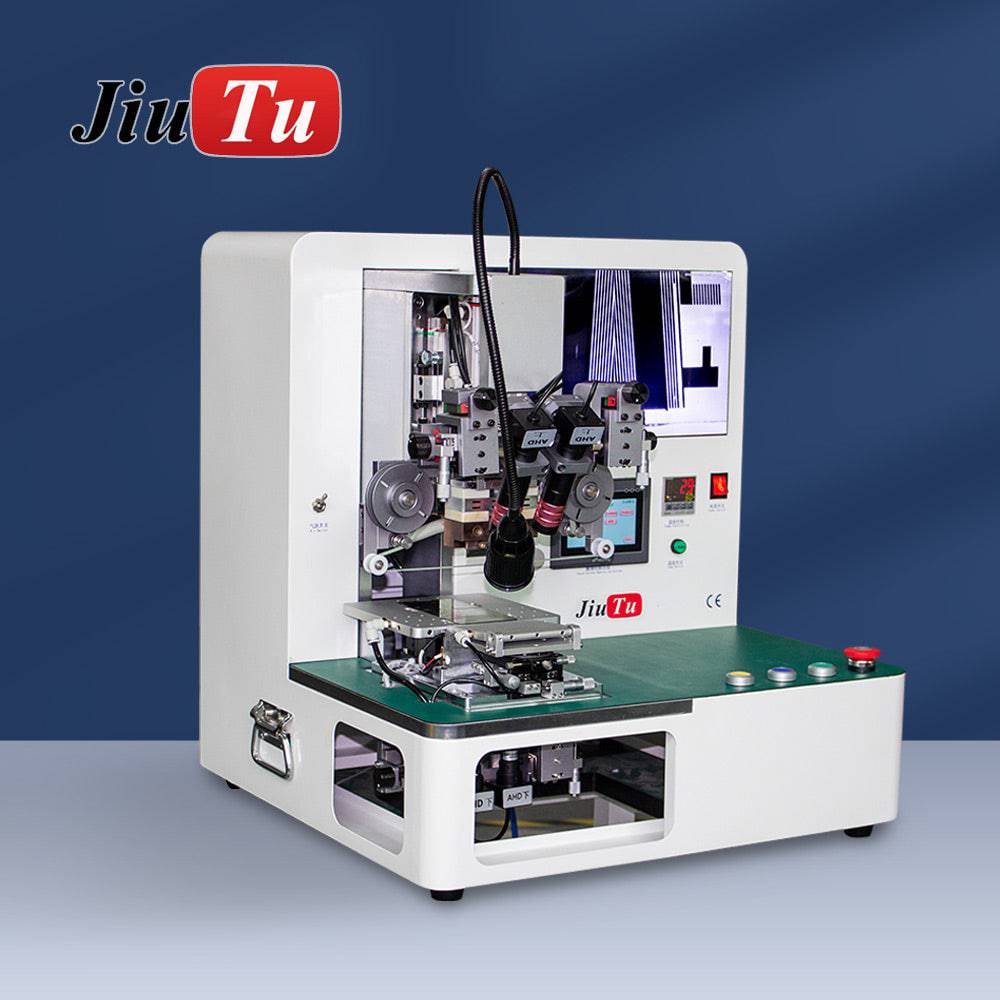
A compact ACF setup often feels most convincing when the workbench is stable, the alignment view is clean, and the thermal area stays controlled from start to finish. See this ACF bonding machine
ACF bonding machine pressure: a contact tool, not a rescue tool
Pressure creates contact, but it cannot rescue weak preparation. If the fixture is uneven, if the support plate is not flat, or if the cable is already drifting, more force usually makes the mistake more expensive. The right amount of pressure creates even contact across the intended bond zone and then stops. Beyond that point, resin starts moving where it should not, alignment becomes less trustworthy, and corners begin to tell a different story from the center.
This is why extra pressure is often the wrong first reaction. If the bond already shows edge squeeze, a glossy crushed look, or slight post-press drift, pressure has probably done enough. At that stage it is usually smarter to check heat delivery, head flatness, and support condition before touching the force setting again.
ACF bonding machine time: small changes, big consequences
Time is deceptively easy to abuse because adding one or two seconds never feels dramatic. Yet dwell time decides how long heat and pressure keep acting after the useful part of the bond may already be complete. A short dwell can leave the joint under-activated. A long dwell can create a bond that looks acceptable at first and weakens later during handling or slight bending.
That is why dwell should be treated as a fine adjustment, not a permanent rescue plan. If temperature and pressure are already close, small time changes can clean up the window. If they are far off, dwell becomes a crutch that makes the first sample look better than the real process actually is.
How to judge a bond before the meter comes out
There is a useful moment just after the head lifts. A good bond usually looks even along its length. The flex sits naturally. Resin presence looks controlled rather than starved or flooded. The corners agree with the center. A weak bond often shows subtle warning signs: one edge looks lighter, the resin line appears dry, or the part seems slightly strained after the press cycle. Those clues should not replace measurement, but they often point in the right direction before electrical testing begins.
On a busy bench, an ACF bonding machine is easier to adjust when operators change only one variable and read the bond carefully before moving to the next trial.
Recommended ACF bonding machine parameters and how to read them
A recommended range is a starting point, not a shortcut. The same number can behave differently on another flex, another head, or another support condition. That is why a good process starts with a narrow working window and small controlled adjustments, not with machine maximums or copied settings. In practice, an ACF bonding machine performs best when each change is small enough to be judged clearly.
A practical rule:
If the bond is close but not clean, adjust in small steps.
If the bond is unstable in several ways at once, stop adjusting and re-check alignment, support, and head contact first.
For most repair teams, ACF bonding machine parameters become more predictable when the first test window is narrow and every follow-up adjustment stays small.
Recommended ACF bonding machine parameters for phone display flex work
Phone repair usually gives you the narrowest process window. The structures are small, the pad pitch is tight, and nearby materials do not tolerate excess heat well. A practical starting band for many phone display flex repairs is around 180–230°C, moderate pressure, and short dwell, often around 6–12 seconds. The exact force depends on head size, stack thickness, and support condition, but the principle is constant: enough heat to activate, enough pressure to contact, and as little extra time as the bond will allow.
On fine-pitch repair jobs, an ACF bonding machine should usually be tuned for control first and speed second.
ACF bonding machine parameters for refurbishment work
Screen refurbishment benches often give you a slightly broader window because the work area is sometimes less cramped and the workflow is more repeatable. A reasonable starting band is roughly 190–240°C with slightly longer dwell than a narrow phone-flex job. The better adjustment path is usually to hold temperature steady first, then trim time in small steps while watching resin flow and corner stability.
In refurbishment rooms, an ACF bonding machine often performs better when the process is repeated with the same support method and the same handling rhythm.
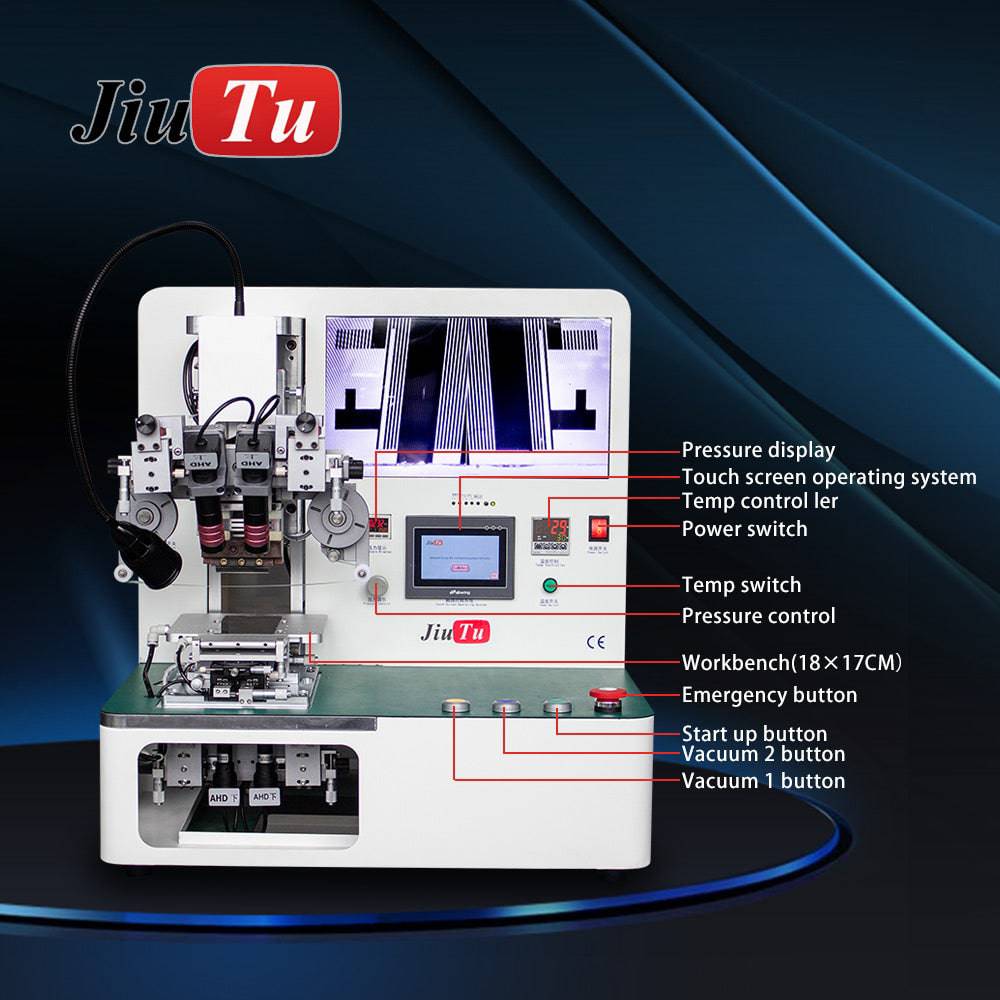
A machine with a clear control layout and a stable work area often makes daily parameter tuning easier, especially when yield depends on tiny adjustments. Compare this ACF bonding machine
ACF bonding machine parameters for industrial display-module rework
Industrial display-module work usually values repeatability more than speed. A calmer starting window often makes more sense: around 170–220°C, moderate controlled pressure, and 8–14 seconds, followed by electrical verification and a light mechanical stability check. For procurement or process teams, the real test is not whether a machine can display a wide range. It is whether it can hold a useful window without making every trial feel like guesswork.
For repeat production checks, an ACF bonding machine should be judged by stability across several samples, not by one clean-looking bond.
If a bond looks dry or weak but stays aligned, a small temperature increase is often the cleanest first move. If the center conducts but one side is unstable, support flatness or force distribution may deserve attention before pressure is raised. If the bond passes the first check and fails after handling, the process may be too aggressive rather than too weak.
For broader electronics manufacturing guidance, see IPC standards. This external reference helps place an ACF bonding machine process within wider assembly quality practices.
Best-fit scenes, pairing ideas, and machine selection
Not every bench needs the same bonding workflow. Some stations mostly repair phone displays. Some live in a rework room where similar jobs repeat all week. Some sit inside a process lab, where the goal is to prove a stable method before volume begins. The same ACF bonding machine can appear in all three places, but the reason it earns its place changes from one scene to another.
That is why the buying conversation around an ACF bonding machine should not stop at headline capability. Does the bench need tight local heat? Does it need flexible visual alignment? Does it need a calmer rhythm for repeated cable work? Does it need easy documentation and repeatability? Those questions usually matter more than the top number on the screen.
Choosing an ACF bonding machine is usually easier when the real application is clear before settings are discussed.
Why phone repair values local control
Phone repair is small, but it is not forgiving. The working area is tight, pad pitch is fine, and nearby structures react quickly. That is why an ACF bonding machine for phone work is usually appreciated for precision and readability under the microscope, not for brute force.
Where a constant-heating workflow fits
A constant heating bonding machine can make sense where repeated cable repair work benefits from a steadier thermal feel. It does not remove process tuning, but it can make daily operation feel calmer once the correct window has been found.
In mixed repair workflows, an ACF bonding machine is often selected because it gives tighter local control where small pad areas matter most.

A steadier thermal style often feels more natural on repeated cable repair work, especially when operators need a routine that stays consistent across the day. See this constant heating bonding machine
The machine never works alone
An ACF bonding machine rarely fails alone. More often, the surrounding routine drifts first. The microscope angle changes, the support plate picks up debris, the tape is cut less carefully, or the part is held with more tension than it should be. Then the whole process feels hard to tune. In reality, the machine may be behaving the same way it did the day before. That is why support, alignment, handling, and documentation deserve just as much respect as the controller settings.
Acceptance steps that actually matter
A useful acceptance routine does not need to be complicated. It needs to answer three questions honestly for an ACF bonding machine: does the bond look right, does it conduct correctly, and does it survive light real-world handling?
1. Prepare the part properly
Before the head comes down, the part should look calm. The pad area should be clean, the tape width should fit the active zone, the support should be even, and the flex should not be fighting the fixture. Many weak bonds are born before the timer starts.
A clean setup helps an ACF bonding machine deliver the same contact condition from one sample to the next.
2. Run three to five samples
One good sample is encouraging, but it is not enough. A short trial series is more useful because it reveals whether the process is centered or only accidentally correct. If the first sample looks perfect and the third one looks crowded or unstable, the process is already telling you something important.
When three to five samples agree, the ACF bonding machine window is usually much closer to being truly usable.
- Bonding head is clean and touches the work area evenly.
- Support plate is flat and the part sits without twist.
- ACF tape width matches the active bond zone.
- Alignment is checked under the working magnification.
- Three to five samples show consistent visual results.
- Bond line looks even from corner to corner.
- Continuity or display function check passes more than once.
- Light handling or bend movement does not create an intermittent open.
- Final settings are recorded with notes.
3. Trust the corners and add one small stress check
The center of the bond often flatters the process. The corners are less polite. They show force imbalance and drift earlier, especially in phone repair. After the visual check, add one small stress test: a gentle bend, a controlled movement, or a second check after light handling. A bond that only survives while lying perfectly still has not really passed.
That extra check matters because an ACF bonding machine process should stay stable after light handling, not only while the part is still.

When your process needs a broader hot press workflow, a related bonding setup can be a useful next step for comparison and workflow planning. Explore related bonding machines
Once the bond passes visual, electrical, and light handling checks, record the full window while it is still fresh. That note saves the next setup from starting over.
Common ACF bonding machine parameter mistakes and daily use tips
By the time a bench says an ACF bonding machine process is difficult, the problem is often not one dramatic mistake. It is a set of small habits leaning the wrong way. Most of them can be corrected once the process is watched more carefully.
Common mistakes
Using pressure to hide weak preparation is one of the most common errors. Chasing every failure with more heat is another. Leaving dwell time as the permanent rescue plan is a third. In all three cases, the first sample may improve while the overall process becomes weaker and less repeatable.
An ACF bonding machine does not usually become difficult by itself; it becomes difficult when small routine errors start stacking together.
Simple judgment tips
Watch how the part behaves when it is picked up. A strong bond usually leaves the flex looking settled. A weaker one can leave the edge looking strained or slightly flattened. Also compare the first and third sample, not just the first one. A process that only wins the first sample has not really won.
For long-term repeatability, an ACF bonding machine is easier to manage when each change is written down with the result.
A better daily method
The best daily method is still simple: change one variable, write it down, and note one observation about what changed. Keep the surrounding routine boring on purpose. The same microscope angle, the same support method, the same tape prep, and the same handling rhythm remove noise and make the process easier to read.
- Does the bond look even from corner to corner, or only in the middle?
- Does the part still look calm after handling, or slightly strained?
- Did the third sample confirm the first one, or quietly disagree with it?
That simple discipline helps an ACF bonding machine process feel understandable instead of random.
Once these questions become part of the routine, the machine becomes much easier to trust. A good process should not feel magical. It should feel understandable.
Extended reading
FAQ
What are the best ACF bonding machine parameters for phone repair?
What matters most in an ACF bonding machine: temperature, pressure, or time?
Is pulse heating bonding better for phone repair?
Why can a bond pass the first test and fail after light movement?
How should an ACF bonding machine for phone repair be adjusted when the corner keeps failing?
What is the best way to compare an ACF machine with a constant heating bonding machine?
A practical closing note
The strongest ACF bonding machine process usually does not look dramatic. It looks steady. The flex sits flat, the corners agree with the center, and the first sample and the third sample tell the same story. That is the kind of process worth building around, whether the work happens on a phone repair bench, in a refurbishment room, or inside a display-module lab.
For teams comparing workflows or refining a process window, Jiutu’s ACF bonding machine, the constant heating bonding machine, and the broader optical bonding machine collection are a useful place to compare thermal style, application fit, and bench workflow.
For many technicians, ACF bonding machine parameters become easier to control once the working window is recorded and repeated under the same bench conditions.
In the end, a well-set ACF bonding machine saves time not because it looks advanced, but because it behaves consistently under the same real bench conditions.